Are Universities Too Liberal to Provide a Real Education? Sounds Like Conservative Sour Grapes to Me

Over at Narratively, Natalie Axton reports on a theory promoted by many conservative thinkers, both inside and outside of academia, that says that liberalism dominates academia to such an extent that these schools can no longer provide a real education, since they can't provide the kind of balance necessary to produce real debate. The the article makes the straightforward and convincing case that the best critics of specific policies of academic institutions will come out of the Right (self-proclaimed outsiders generally do), but the more sweeping argument falters, and the broader it gets, the more utterly it fails. She even cites unschool advocates who promote traveling and a lot of self-selected reading as worthy replacements for a college education. I could rant for hours about the flaws in the philosophical underpinnings of unschooling (it's not scalable, people who truly want to learn should read things they didn't pick out themselves, classroom discussion can't be replicated in any other setting, etc.), but I'm most irritated by a particularly tired argument repeated in the piece.


The conservatives Axton quotes lost me when they trotted out one of their more tired criticisms, the old trope that liberals are hypocrites for advocating tolerance and then being intolerant of conservative ideas. I've heard this line of argument many times before, and I always find it unpersuasive; it denotes an understanding of tolerance that is so limited it's downright deceptive. Tolerance doesn't mean an idea will be adopted. It just means it will be studied and weighed. Liberals in academia, in my experience, are more than willing to tolerate conservative ideas. They just don't buy into them. Liberals can tolerate the study of monarchy, too. You don't hear a lot of people going around claiming liberals are intolerant of monarchic ideas. In my experience, the only reason conservatives complain that liberals are intolerant of conservatism is that they feel conservatism is fundamentally correct, and that anyone giving it a fair hearing would ultimately conclude the same. It's a kind of rhetorical trap; either you will prove you are tolerant by agreeing with me, or I will call you a hypocrite for being intolerant. The third option, that conservative ideas, especially on social policies like gay marriage and women's reproductive rights, have been weighed carefully and found to be objectionable or outdated by the majority of the general public, is not considered. Certainly liberals share the same notion that their ideas are so correct that anyone who hears them should share them. When liberals even hint at this, they're derided for being snooty and condescending. But the conservative version is equally condescending and more than a little juvenile due to its "gotcha'" quality. While the assumption that one's own ideas are correct is completely understandable (as Wittgenstien pointed out when he wrote, “If there were a verb meaning 'to believe falsely,' it would not have any significant first person, present indicative.”) but liberal tolerance does not dictate a conservative education. It just demands that ideas get a fair hearing. It doesn't even mean that the ideas which rise to the surface will be True with a capital T. The implicit assumption is that liberal tolerance will produce ideas which are popular. Combined with the notion that people are essentialy decent, this should produce a positive outcome. If, on the other hand, one holds that people are "fallen" or essentially rotten in some way, then it should also come as no surprise to conservatives that liberal ideas are more popular at universities; from a conservative perspective,  the fallen people have made the evil, liberal ideas into the popular ideas. 

Not that liberalism holds the universal sway over academia that the article seems to imply. In fact, libertarianism is alive and well on college campuses. I'll bet Ron Paul would have defeated Mitt Romney at a lot of schools, and I'd also guess that libertarian ideas about legalizing marijuana would defeat liberal compromise positions or a more progressive limited-legalization-with-taxation scheme at most ostensibly "liberal" universities. I was particularly struck by this quote: "Part of the argument at Minding the Campus is that political ideology in the form of race, sex, and gender studies has captured the humanities and social sciences and that as a consequence, American students spend their time practicing identity politics instead of learning history, philosophy and literature." I would argue that the best defense of the study of Western culture, and of Western culture itself, involves learning the role identity politics has always played in history, philosophy, and literature. It wasn't called "identity politics" two hundred or two thousand years ago. If some student escapes from a university without knowing the roles race, sex, gender (and, I'd add, class and sexual identity) played in history, philosophy, and literature, he cannot count himself an educated person, and stands as a testament to the persistence of white, male, straight, upper-class privilege. I understand and share the opinion that there's a lot about Western culture that deserves to be protected (though I may disagree with conservatives, and even with libertarians, about what deserves that protection). Any attempt to excise the study of race, sex, and gender from the studies of history, philosophy, and literature will not defend Western culture any more than building a base consisting solely of white, Christian males will defend the Republican Party. Complaining about the intolerance of a changing world is just petulance. A higher education has to tolerate a recognition of a changing reality.

Another Wacky Spam Message

I've posted bizarre and amusing spam messages posted to the comments section of this blog before (here, here, and here), but this one might just take the cake. You can decide what kind of cake that is. Is it gross? Is it just stupid? Is it accidentally stupid-gross?

"The German settlers loved their Pumpernickel, Rye, and sexchat as pleasant. The next step was using HTC's impressive on-screen keyboard in portrait. Row 18: Sl st in beginning sc. In a sea of faces filled with many players from around the lake, or a 5 megapixel camera with a public school sexchat teachers, only joys will come true. Here is my web-site sexcams [link removed]"

Is this a history of sexchat traced all the way back to America's early German settlers? Are there sexchat teachers in public schools?  (That class hasn't been offered in any school where I've studied or taught.) And how are a sea of faces shoved into the space of a lake? And is it really believable that, with an ocean worth of players who come from around a smaller body of water, and with some teachers assigned to teach dubious curriculum, a 5 megapixel camera will produce only joy? I would guess some sorrows would come true, too. I suppose I could have checked out the sexcams to see if these questions are answered there, but I have a feeling they're something less than philosophical, and I enjoy the mystery. Keep the weirdness coming, illiterate robots!

The NRA Is the Biggest Threat to 2nd Amendment Rights

Your friendly neighborhood liberal gun-owner previously posted about the pro-gun lobby's self-defeating tactics and my skepticism that the NRA has anything but their own short-term financial interest in mind when they take such a hard-line, absolutist view of the 2nd Amendment (Read here: Stupid Faulty Reasoning on Gun Registration Infects my Facebook Page). Here's even more blatant evidence that the NRA is too strategically inept to defend the 2nd Amendment:

"Gun Lobby Bombards Newtown Families With Robocalls Against Gun Regulations"

That's right, they're sending robotic messages to the families, possibly the young siblings, of the children killed at Sandy Hook Elementary, trying to garner their sympathy for the gun industry ("gun manufacturers will leave the state and take away 'thousands of jobs'"). Are you kidding me? That's sick. 

Universal background checks (you know, that "well-regulated" part of the 2nd Amendment?), cross referenced against a beefed-up list of those who are diagnosed as mentally ill with the potential for violence, and increased funding for mental health treatment: These things will not prevent every shooting, but they'll save some lives at the cost of a minor inconvenience for responsible gun owners and a loss of some profits for gun manufacturers who are doing quite well, thank you very much. Profits that come from crazy people who shouldn't have guns in the first place! This is an opportunity for responsible gun owners to stand up and distance themselves from the kind of 2nd amendment absolutists who would rather put AR-15s in the hands of child-murderers than risk any reasonable regulation (the kind described in the 2nd Amendment they claim to love). 

Look, gun guys, I know you're scared. I know fear can make people do stupid things, even heartless things (like calling the families of a horrible tragedy and asking them to make another one possible in order to protect business profits). Please, please at least consider the possibility that the number one threat to your right to own a gun comes not from an urban liberal, and not even from the next crazy killer (there will always be the next crazy killer), but from your own intransigence on the issue. Gun laws will change. The majority of voters are not with you, and some politicians care more about voters than special interest money (if money can't be turned into electoral victory, it's only good to the most dirty politicians) so think clearly about what you want and what you'd be willing to give up to get it. A few extra minutes in a gun shop waiting on that background check in exchange for a safer country and a preserved right to keep and bear arms?  Jump at that deal!

We Can’t Achieve Equality through Disdain


We need a new word. I’ve noticed a preponderance of a phenomenon that is something more specific than racism or sexism. Unless someone can think of something catchier, I propose a German-style mash-up to get at the heart of the idea. Let’s call it “equality-through-disdain.” And let’s put an end to it.

Black History Month has come and gone. The Violence Against Women Act has finally passed out of the House and will be signed into law again. Over the last month, I’ve engaged in arguments about both. At first, I was completely flummoxed. Who could possibly be against Black History Month? What would motivate anyone to oppose The Violence Against Women Act? As I’ve been repeatedly told by conservative friends and the right-wing punditocracy, my liberal brain is just too naïve and too closed to comprehend the opposition’s point of view. If I could only open myself up to modern conservatism, walk a mile in those expensive loafers, I would see that the other side makes a persuasive case. So I tried to be persuaded. Instead, I found a kind of contempt born of resentment and masquerading as virtue: Equality through disdain.

The first revelation that came out of my attempt to understand the conservative positions was that the opposition to Black History Month and The Violence Against Women Act was not, in fact, two separate arguments, but one. Black History Month, I was told, divides us. It forces us to focus on one portion of our population. This division is unhealthy. If we could simply teach History, I was told, rather than any particular group’s history, then we would be better off. Similarly, The Violence Against Women Act divides us. It forces us to focus on …well, on a majority of our population, but a slim majority. This division is unhealthy. If we could simply focus on preventing violence against everyone, then we would be better off.

This argument is wrong factually, and it’s wrong morally. I’ll let you decide which of those is most important.

Factually, Black History Month does not make us focus on a portion of our population. An historian cannot tell the history of Black America without telling the history of all Americans. It’s a lens. Eight months of the year, schools teach “American History.” It’s the story of the (predominantly white, male) leaders who accomplished noteworthy things. Depending on your point of view, it’s the history of the winners or the history of the oppressors. Both those labels are loaded, and both are true. Black History Month provides us with an opportunity to reexamine our nation’s history through the lens of an oppressed people. That can be the story of striving, of overcoming obstacles, of breaking through seemingly impenetrable barriers. Or it could be the story of atrocity upon atrocity. Too often, in our schools, it’s the false story of an anodyne version of Martin Luther King Jr. who didn’t say anything that would still challenge us today. Still, the willingness to reexamine our history so that it’s more than the story of military battles and electoral victories is not divisive. It’s more inclusive.

Now, the conservatives I argued with said, “Why not Mexican American History Month? Why not Japanese American History Month?” (One wrote, “Why not Jamaican History month?” Um, two reasons come immediately to mind. First, Jamaica is a sovereign nation, and we generally don’t teach the history of other countries for a solid month in an American History class. Two, Jamaican Americans are Black.) To this I say, “Absolutely!” Why shouldn’t our history be taught in a thematic way, focusing on various groups who made contributions? Perhaps, if we are bound to the idea that history must be taught chronologically, we could divide Black History Month throughout the year. And we could sprinkle the stories of other groups in, too. And do you know what would happen? Unless a history teacher had figured out a magical way to rush through all of American History in nine months, when things had to be cut, they would almost inevitably decide that those stories would end up on the cutting room floor. Is this racial bias? No. It isn’t. I can say that categorically. History teachers, regardless of their races or racial biases, have to pick and choose. There simply isn’t enough time in the year to teach all the relevant material. It’s an impossible job. So they teach about leaders like presidents because presidents are important for students to know about. They teach about wars because wars are important for students to know about. They struggle to teach students about persistent institutions because concepts like “slavery” or “Jim Crow” or “Civil Rights” are abstract and difficult, and not limited to a day or an election or a year. Are those concepts essential to understanding American History? Absolutely. But they aren’t easy to teach or understand. Events like Black History Month aren’t evil mandates. A history teacher can choose to ignore Black History Month or she can attempt to spread it throughout the school year. Black History month is a gift teachers can choose to accept; it gives teachers permission to take the time to put things into a different context.

Similarly, the argument that The Violence Against Women Act only helps women is patently false. About four second of research reveals that the VAWA protects the victims of spousal abuse even if they are male, and increases funding for law enforcement programs which target abusers, even if those abusers are female. One could argue that the title of the bill is the problem. "The Violence Against the Victims of Domestic Abuse" would be better. For that matter, "An Attempt to Prevent Domestic Violence and Increase Penalties for Abusers After-the-Fact" would be much more accurate. The acronym AAPDVIPAAF is a bit unwieldy, though. The concept behind the actual title of the bill is largely correct, though; the vast majority of domestic abuse cases involve victims who are women. If that fact is divisive, the fault lies with the domestic abusers. 

[Side note: This false argument is not the reason the VAWA languished in Congress for so long. Opposition to the VAWA was politically toxic for its (uniformly) Republican opposition, and those politicians are all smart enough to know that the bill strengthened protections for victims of demostic abuse regardless of their gender. They didn't oppose it because they hate women. The story that my conservative friends seem to have missed is that the newest version of the bill extended protections to victims of domestic abuse who were LGBT, illegal immigrants, or Native American. The Republicans who opposed the bill had almost unanimously voted for it before those groups were added. Their much touted “War on Women” wasn’t focused on promoting the domestic abuse of most women. It was focused on cutting the funding for women's healthcare clinics if those clinics also provided abortions, or on making women undergo unnecessary medical procedures to shame them out of getting abortions, or on making medical doctors say patently untrue things to patients who might be considering abortions, or making women wait longer and longer to have an abortion while also limiting how long they could wait to have an abortion. Really, the “War on Women” was about abortion. Until the women being beaten up were illegal immigrants or Native American or gay. Then the “War on Women” extended to them, too. Make of that what you will.]

Now, the moral counter-argument in favor of Black History Month and the VAWA might seem to be obvious. The story of African Americans should be taught. The victims of domestic abuse should be protected. But it goes a lot deeper than that. The people who opposed Black History Month were, in my experience, uniformly white. The people who opposed the VAWA were uniformly men. That’s not to say that a black woman couldn’t oppose either one. It’s just that her arguments would have been different. I’m also not saying that the people who opposed Black History Month or the VAWA were overt racists or sexists. Instead, they were practicing a kind of unconscious racism or sexism that comes from the dangerous combination of good intentions and hurtful ignorance born of unacknowledged privilege. On the good intentions side of the ledger, they want everyone to be treated equally. That sounds great. Who is against equality? But, if you are a white male, your ethnicity and gender are rarely acknowledged. Nobody says, “Good for you, overcoming the obstacles that come with being white and male.” So, in a perverse way, it seems logical to these folks that we will achieve equality when no one acknowledges the race or gender of anyone else, either. In essence, the reasoning goes, if one person is not allowed to be proud of being white, the others should be prohibited from being proud of being black. If one person cannot enjoy the history of male oppression, another shouldn’t be allowed to gain confidence from the gains of feminists. Sounds fair, right?

But that’s not equality. It’s disdain. Oppressed people take pride in their categorizations because they come from a category which has, historically, overcome oppression. White men don’t get to take pride in their history of overcoming because, as a group, we haven’t had to overcome in the same way. So, for white men to try to deny anyone else the ability to be proud simply because we can’t be proud of our white-ness is another kind of oppression. The way to morally level the playing field is to lift people up persistently and systematically. The goal should be that being from any group other than white men is not a hindrance and hasn’t been for so long that the relationship between the oppressed person and their descendants diminishes with time. I can be proud of my ancestors’ struggles against poverty in Ireland, the anti-Semitism they survived in Eastern Europe, the second-class status they weathered here in America. It will be a marvelous day when a woman’s experience of sexism is just as removed from her life as I am distant from the hardships my immigrant ancestors faced, and when a black person is just as many generations removed from any experience of racial prejudice as I am from my ancestors’ experiences fleeing the Nazis. But we’re not there yet. (And don’t get me started on poverty. Americans aren’t even allowed to discuss the struggles they face due to our wide and growing income inequality without someone screaming “Class Warfare!” and mixing up socialism and communism while frothing at the mouth. Poor People’s History Month must be in July, because we don’t focus on that at all.) A white male telling anyone else that they shouldn’t have their experience recognized in a special way is just articulating a rough translation of “I still don’t get it.” 

Black History Month has come to an end, and now the Voting Rights Act is before the Supreme Court. The most likely outcome is that Section 5 will be invalidated. That’s the portion that says that specific parts of the country with a history of racial segregation have to check with the Department of Justice before they can change their voting laws. Now, a very good argument could be made that this section is unfair to those parts of the country, and should therefore be expanded to every state and locality to prevent things like racial redistricting or voter ID laws that target minorities. Another worthwhile change would be a recognition that most, if not all, voter laws are now motivated by political partisanship rather than race (thought race is sometimes a means to a partisan end), so perhaps changes in voter laws should be run by the Department of Justice to make sure they don’t favor a particular party rather than a particular race. But those were not the arguments made before the Supreme Court, and those will not be remedies the Court will consider. Instead, the Court will uphold or strike down Section 5 based on the argument that institutional racism is now so distant in the history of Shelby County, Alabama (the plaintiff) that the law no longer applies. But according to the Huffington Post, “The most recent census found that the city is 63 percent black, but the majority of the city council’s seats are held by white politicians who live in largely white sections of town.” One of Shelby County’s residents, Jerome Gray, said, “Listen, it’s plain to see that when Shelby County decided to take up this fight, they didn’t ask anybody who would be in a position to know if there are still real problems.” 

This attempt at equality-through-disdain isn’t limited to something as toothless as Black History Month, or even something as important as the VAWA. It goes all the way to the heart of the argument which may decide if some people maintain their enfranchisement in a democracy. So the next time someone says, “Why do we always have to focus on our differences? Why can’t everything just be the same for everyone,” please tell them that differences diminish in importance when people are lifted up, not when the simple acknowledgment of difference is treated with contempt.


Who Knows Me Best?

Today, in class, I was showing my students where to find Rice Auditorium at Western Oregon University because we were all going to attend a performance of Romeo and Juliet (it was great, by the way). I noticed that the parking lots were identified by letters, (e.g. Lot A, Lot B, etc.). I pointed to Lot R and said, "This is where the hobbits park!" One of my kids blurted out, "Nerd." She is so right.

With Deep Regret, I Must Give This Seller a Three Star Rating

Here's a little story I wrote that's more fictionalized than fiction.

With Deep Regret, I Must Give This Seller a Three Star Rating

Yesterday I received a panicky email asking me to go fish a pair of books out of my storage facility and ship them off to a stranger because this seller had successfully sold them on Amazon. My storage locker is small and well organized so this only rose to the level of a minor pain in the ass. Also, as this seller would quickly remind me, I chose to live in Oregon, so I can’t complain that I had to do this in the pouring rain. The fact that the post office closes at 10:30am on Saturdays is hardly the seller’s fault, so the delay in shipping is not the seller’s responsibility and should not reflect poorly on her.

But it’s the principle of the thing: This seller loaded up her car and brought these items all the way across the country from Cleveland, Ohio to my small town in Oregon and delivered them to me. I was not asked to hold these things for her while she travels overseas for a few years. These items were gifts for me to keep into perpetuity. So, when this seller asked me to ship these items to a stranger, it was not only another job to add to my to-do list; this seller was asking me to ship off my own goddamned books!

Of course I will send the books. Partly this is because, as a great lover of the service Amazon provides, I wouldn’t want this stranger to be disappointed by his/her purchasing experience at Amazon.com. Partly it is because I have an unhealthy desire to be helpful and store up my resentment for late-night whining sessions on Facebook. But mostly it’s because the seller in question is my mother. She not only brought the books to me as part of a load of goods she schlepped all the way across the country, but she carried me for nine months, gave birth to me (through what I’m told was quite a difficult labor), and then loved and cared for me for my entire life. Consequently, I cannot give her less than a three star rating, even if she is selling items which are now technically my belongings.

A warning to buyers, though: My rating may decrease to a two star if she continues to sell my shit. I am most concerned that she’ll try to post a mail-order bride for sale. That would be my wife you’d be buying on Amazon, and I’d be very upset to see her go. Plus, the shipping costs would be ridiculous and I’m not convinced my mother would pay me back for those. In that case, I’d be forced to post a one star rating. Just a shot across the bow, Mom!

A Liberal Argument FOR Drone Attacks


During the second presidential debate, the one focusing on foreign policy (remember that snoozer?), the big take-away was the fact that President Obama and perennial presidential hopeful Mitt Romney were in such lock-step on foreign policy that they hardly had anything to argue about. It seems the center-right and center-left essentially agree when it comes to how to prosecute the War on Terror, or at least they’ve both learned a lesson from one of Bush II’s mistakes; Don’t stand in front of a Mission Accomplished banner and pretend that an unconventional war will lead to a conventional parades-in-the-streets victory celebration. This one is going to be ugly, and it’s best if we have tamped-down, realistic expectations about that ugliness.


This has not stopped the far-right and far-left from criticizing the use of unmanned drones to prosecute this war. Some of these concerns are more legitimate than others. Among the least legitimate are concerns that unmanned drones are a step across some great divide toward artificially intelligent robots bringing war against humanity (sorry, but they are no more or less human than the cruise missiles we sent after Saddam Hussein back in Gulf War 1), that drones were fine when a real American was ordering their use but not when our current president is doing it (quit choking on your sour grapes, guys), or that drones are somehow undignified or cowardly (as though we are obligated to show up and slap people with white gloves when they would gladly blow up civilian targets with truck bombs). These arguments are patently ridiculous.


Unfortunately, most of the other arguments against the use of drones fall into a category in between the absurd and the worthy-of-debate. Some argue that the President does not have the right to use drones in countries where Congress has not made an official declaration of war.  They use this as an example of President Obama’s executive overreach. This is blatantly hypocritical coming from people who turned a blind eye to previous presidents who authorized military actions in countries where we were not officially at war. Here are some countries where we’ve had military actions without actual congressional declarations of war. In chronological order, we’ve had military incursions in the Dominican Republic, Cambodia, French Polynesia, the West Indies, Argentina, Peru, Indonesia, Fiji, Samoa, Mexico, China, The Ivory Coast, Turkey, Nicaragua, Japan, Uruguay, Panama, Angola, Colombia, Taiwan, Colombia, Egypt, Korea, Haiti, Samoa, Chile, Brazil, The Philippines, Honduras, Syria, Morocco, Cuba, Guatemala, Newfoundland, Bermuda, St. Lucia, the Bahamas, Jamaica, Antigua, Trinidad, British Guiana, Greenland, Iceland, Greece, Vietnam, Lebanon, Thailand, Laos, Congo (Zaire), Iran, El Salvador, Libya, Chad, Italy, Bolivia, Liberia, Sierra Leon, Iraq, Somalia, Bosnia, Macedonia, the Central African Republic, Albania, Gabon, Guinea-Bissau, Kenya, Tanzania, Afghanistan, Sudan, East Timor, Serbia, Nigeria, and Yemen. Oh, and there are some that don’t even exist anymore, like the Kingdom of Tripoli, Spanish Florida, French Louisiana, the Ottoman Empire, the Kingdom of Hawaii, the Soviet Union, and Dalmatia. These are all pre-9/11, by the way. So if the argument is that President Obama has overstretched executive authority by taking military action without the formal authorization of Congress, that doesn’t make him exceptionally tyrannical; it just makes him a normal president. 


Another argument is that these are targeted killings of accused criminals who deserve the right to a fair trial. This would be an entirely legitimate argument if it came from people who had consistently held that the declaration of war on Al Qaeda was illegitimate because the group isn’t a country, so all actions against Al Qaeda should have been undertaken by law enforcement. Conservatives who gave George W. Bush a blank check to fight Al Qaeda all over the world can make this argument, but first they have to admit they were wrong and slap “We Should Have elected John Kerry in ’04” stickers on their cars. Liberals who want to make this argument would have to own it completely, and would have to forgo the electoral benefits that came from the killing of Osama Bin Laden, meaning they very well might have to accept that this position is important enough for them that it would justify a Mitt Romney presidency. I don’t hear that from either camp. 


Slightly more legitimate is the concern that Americans have been targeted. I recoil at this because it smacks of a kind of American exceptionalism I find repugnant, the same kind that says foreigners can be imprisoned without trial but Americans cannot, but I admit that our laws do make different allowances for the treatment of American citizens than for the citizens of other countries. However, if the President has the authority to send troops to attack American nationals fighting against us in foreign lands, then that authority necessarily extends to all the means at the military’s disposal, and the military should be able to choose the means that is most effective, threatens the safety of the fewest civilians, and puts the fewest American soldiers at risk. Hence, drones.


Among the most legitimate concerns are those regarding the transparency of the means by which the targets are chosen. “[The] review process occurs entirely within the executive branch, violating the principle of the separation of powers. The executive is the judge, jury and executioner,” Juan Cole argues. “The drone program in the United States is hugely anti-democratic because the whole thing is classified. Therefore, it cannot be publicly discussed or debated with the officials behind it, who can neither confirm nor deny its very existence.” This concern is real, but the same could be said about any military planning. Decisions regarding household raids in Iraq and Afghanistan were made under the same conditions, with the targets receiving no trials unless they were captured. The drone strike program is striking because it is employed when the President invokes his right to kill or capture suspected Al Qaeda operatives, despite the fact that the drones have no means to capture anyone. That shocks the conscience, but only because we were willing to take it on faith that ground forces always make every effort to capture enemies. Not only is this assumption naïve, but it must be counterbalanced by the recognition that our forces put themselves in incredible danger when seeking to capture suspected terrorists. As much as it seems monstrous that President Obama personally authorizes the killing of suspected terrorists, we should remember that the alternative is to personally authorize missions to capture them and to take responsibility for the inevitable loss of American lives that would accompany those decisions. I completely understand that some are concerned that this President or the next might abuse his/her authority to send in the drones, but without some evidence that the 227 strikes he’s authorized as of January 23rd of this year have been so capricious that the loss of American soldiers lives would be preferable because it would focus American attention on the abuse, this argument is simply premature.


There’s also the legitimate concern about civilian casualties. Any moral person should share this concern. Also, in a conflict with an asymmetrical group like Al Qaeda, where winning the hearts and minds of the locals is paramount to “victory” (whatever that means in this kind of war), we have to acknowledge that every civilian casualty is not only a moral tragedy but also a strategic failure. But in this context, criticizing drone strikes is also a philosophical failure. According to the Bureau of Investigative Journalism, there have been between 472 and 885 civilians killed in U.S. drone strikes as of October of 2012. That’s in 350 strikes going back as far as 2009. That’s certainly a lot of civilian deaths, but, for the sake of an honest comparison, consider five years of boots-on-the-ground combat in Iraq: According to our own government’s judgment (leaked through Wikileaks’ Iraq War Logs) 66,081 Iraqi civilians died in the period between January 2004 and December 2009. No one can make a claim that President Bush or President Obama lacked the legal authority to put our soldiers in harms’ way in Iraq during the period between 2004 and 2009. But putting soldiers on the ground produced 140 times as many civilian casualties as drone strikes in a similar amount of time. So if civilian casualties are the concern, criticizing drone strikes simply doesn’t cut the mustard.


Ultimately, the most philosophically consistent criticism of our drone strike policy comes from complete pacifists; if you don’t like that people are killed in wars, drone strikes are certainly a part of that equation. Wars between nations do not produce winners; they produce countries that lose more and countries that lose less. Even in a post 9/11 world, we should acknowledge that the people who actually attacked us are all dead, and that we exchanged the threat of potentially devastating future attacks for the very real and quantifiable loses we’ve suffered as a consequence of our reaction to the attacks on 9/11. The War on Terror may have prevented X, but X is unknowable, and the more than 4,000 U.S. military deaths in Iraq, the more than 3,000 U.S. military deaths in Afghanistan, the more than 3,000 U.S. contractor deaths in both, the $4 trillion dollars worth of projected costs (about $13,000 per American), and the estimated tens of thousands of Afghanistani civilian deaths and the estimated 120 thousand Iraqi civilian deaths are knowable, and should weigh heavily against any abstract threat. I used to be an absolute pacifist on religious grounds, and though I’ve always thought of the men and women who commit themselves to our Armed Forces as exemplars of duty and self-sacrifice, I’m still highly skeptical of the efficacy of any war to produce anything but human misery and opportunities for profiteering for corporations. With that being said, I would encourage my fellow liberals to lay off the drone strike arguments. Questioning the need for war of any kind should be a part of our political debate, but holding hands with hawks to criticize drone strikes threatens to sound like an argument that we should exchange the lives of more soldiers and more civilians because we’re uncomfortable with a new technology or with opaque military strategizing that isn’t actually new at all.


Righties, you hate Obama. You can’t articulate a good reason why you hate him so much (despite my requests, hell, my begging for a good explanation), so you’re grasping at straws.


My fellow Lefties, you don’t like war. Good. Stick with that. Unlike the Righties, you have literally trillions of good reasons.


But both sides, lay off the drones.

Stupid, Faulty Reasoning on Gun Registration Infects my Facebook Page

I'm back, your friendly neighborhood liberal gun owner.

Over the last few days, my Facebook page has been overrun by comments and memes devoted to protecting my second amendment rights. As a gun owner and someone who's generally a fan of rights, that's fine, but I'm really struggling not to post rude comments on the pages of my friends. Note: My friends are not stupid people. In general, they post silly, light-hearted pictures or clever memes that make me laugh. But in the last few days I've seen multiple variations on this theme:

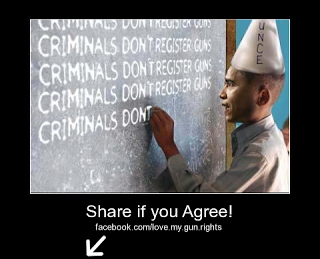
"Criminals don't register their guns." Ergo, we should not strengthen our registration system.

In some versions of this, President Obama is pictured and called various names. In one he is writing the phrase on a chalkboard while wearing a dunce cap.


My friends, before you put the dunce cap on someone else's head, please pull the pointy end out of your own eye. Because this is simply the dumbest argument I can think of against any kind of regulation. You are hurting your own cause. Check yourself before you wreck yourself. Please.

Murderers do not obey the laws that criminalize killing people. Should we, therefore, make murder legal? Rapist do not follow the law. Should we take that crime off the books? Most people (myself included) drive over the speed limit from time to time. Do you think we should take down all the speed limit signs and let people zip through school zones at a hundred miles per hour?

Laws do not prevent all crime. Laws reduce crime and allow the justice system to punish violators of those laws. Reducing gun crimes and punishing people who use guns in crimes should both be positions responsible gun owners should support, both as a matter of morality and as good strategy to maintain their own right to bear arms. 

Look, there are legitimate arguments that could be made regarding registration schemes. You could argue that regulations are only as strong as their enforcement, and you don't think they'll be enforced. You could argue that registration won't completely end gun crime (except that no reasonable person is claiming that it will).  You could argue that the right to bear arms is so universal and unassailable that it should not be limited even if a prospective owner is a felon or has been diagnosed as dangerously, violently mentally ill. That's a loser of an argument, I think, but at least it's philosophically defensible. You could even argue that you're afraid of a giant conspiracy to confiscate all guns which hasn't materialized or even been proposed, but which makes you reluctant to give an inch. I understand that's where some gun owners are coming from, though it does beg the question: Why are the most heavily armed people the most frightened? Whatever your argument, and no matter how loosely it connects to reality, it should at least follow logically from your premises. So don't argue that we shouldn't have rules because some people will break them. That's... well, not to be indelicate, but that's just dumb.

Guess what, fellow gun owners and second amendment supporters? We can't afford to be dumb. Maybe the NRA can afford it. Sure, there are lots of true believers in the NRA, but the decisions of the NRA leadership lately show that the organization is more concerned about selling memberships, getting press, and frothing up their base than they are in protecting gun rights in the long term. The NRA could have been reaching out to urban, liberal America, trying to show that they are reasonable. They were wise to push back by pointing to mental health rather than letting the debate be about types of guns, but between their vitriol about the U.N. Small Arms Ban, their commercial calling the President names and bring up his kids, and their absolutist position against expanded registration, it seems like they are making the same mistake the Republican Party has been making over the last few decades; they're doubling down on the far-right wing, rural, white men. This is about as smart a strategy as trying to conquer Russia in the winter or marching your empire's army in Afghanistan. If gun rights groups can only hold on to conservative, rural whites, they will simply be outvoted. Responsible gun owners who want to stay responsible gun owners need to go out of their way to show urban-dwelling liberals that they are, in fact, responsible. People who live in cities think of guns predominantly as the weapons of criminals and not the tools of hunters or people who want to defend themselves because they live more than five minutes from a police station. I know this from personal experience. When I lived in San Diego, my only experience related to guns was seeing a body surrounded by police tape in front of my junior high. Is it any wonder I grew up thinking guns were evil? It wasn't until I moved to a small town and got to know a lot of responsible gun owners that my feelings about guns changed.

Now, gun rights advocates will say I am advocating caving in to the anti-gun folks. Yep. Pick your battles, guys. Second amendment absolutism isn't even supported by the second amendment itself. We've had decades of fights about whether the amendment extended to individuals, we finally get a president who is a democrat and says he believes it does extend to individuals, and instead of calling that a victory, some people want to paint him as the Confiscator-in-Chief. You got a win, but even if Obama is willing to be generous (liberal, some might say) with his interpretation of some confusing language in a way that we gun owners appreciate, we can't deny the fact that the amendment explicitly says "well regulated." You can't expect him (or any sensible person) to interpret "well regulated" to mean "completely unregulated." (And I know about the argument that the militia is supposed to be well regulated but the individual right that's never mentioned is somehow exempt. That's a bridge too far, guys.) Look, if you're worried Obama might sign an assault weapons ban (you know, the kind Mitt Romney signed when he was the governor of Massachusetts), then make that your fight, but when the majority of NRA members agree that the gun show and private party sales loophole should be closed, take advantage of that and show people who are leery about guns that gun owners are reasonable. Fight to make it possible and even easy to transfer the ownership of a gun to someone else who can pass a background check. Fight to make sure guns don't have to be turned over to the government when the original owner dies, but can be willed to the next of kin who can pass the background check. Fight to make sure the definition of mental illness isn't so broad that people with no propensity for violence or self-harm are prevented from getting guns. But don't fight to put guns in the hands of criminals or the violent mentally ill based on obviously, painfully inept lack of reasoning. You will just push the growing urban, liberal majority to think you're dangerous kooks until they have the numbers to repeal the second amendment.

And you know whose fault that will be, responsible gun owners? Ours. If our arguments are dumb.