Review of Tamsyn Muir’s NONA THE NINTH

Cover of Tamsyn Muir’s None the Ninth, art by Tommy Arnold

⭐⭐⭐⭐⭐

I'm going to be careful here so I don't spoil anything about this novel or its predecessors. Consequently, this review will be cryptic and largely unusable. In short, Nona the Nith introduces us to a maybe-new character who is absolutely delightful. The novel also alternates back and forth with a narrative told in a different point of view like Harrow the Ninth, but this other narrative seems to be set so far away from the universe we've previously explored that we initially question if we're even reading the same book or in the same universe. (We are. It all comes together.) The ending is very to-be-continued, and if I hadn't been able to quickly find an interview confirming that Tamsyn Muir is writing the fourth and, she says, last in the series, I probably would have left this one with a more bitter taste in my mouth. But the titular protagonist is so wonderful, I can't give this less than 5 stars, and once it's bookended, its ending will be justified.  

Review of Tamsyn Muir’s HARROW THE NINTH

⭐⭐⭐⭐⭐

Cover of Tamsyn Muir’s Harrow the Ninth, art by Tommy Arnold


I was telling a friend, author Erik Grove, about how much I enjoyed Tamsyn Muir's Gideon the Ninth and was looking forward to the sequel. He warned me about the structure. It's not a spoiler to reveal that the novel is told in a pattern of alternating accounts, one in 3rd person about Harrow, and the other in what some people call 2nd person (which is really 1st or 3rd but about a 2nd person protagonist). Erik also warned me that he found the first half of the book slow and sometimes so confusing that he was tempted to put it down, but that the ending redeemed it. I'm grateful for the warning; I doubt I would have put it down, but I was grateful to know it would resolve in this book and not in some future volume. And resolve it did! Muir does a wonderful job of balancing a mystery between "When will we find out?" and "When will the characters find out?" This relies on making the reader care so much about the characters that their discovery is just as important to us as our own, and in this one Muir manages to make characters who were less important, absent, or off putting in the first book into characters we care about so much that we desperately want them to figure out what we have been suspecting as much as we want our own submissions confirmed or refuted. The novel does resolve it's main question but leaves a huge mystery about a character's motive to be addressed in a future installment. I'm not sure if I can conclusively say if I liked this novel more or less than it's predecessor. Gideon The Ninth is slightly less demanding fun (though there are still two competing puzzles at the heart of that book), but this one felt more rewarding when it all came together. And, of course, I went immediately on to Nona the Ninth the second I finished this one.

Review of GIDEON THE NINTH by Tamsyn Miur

⭐⭐⭐⭐⭐

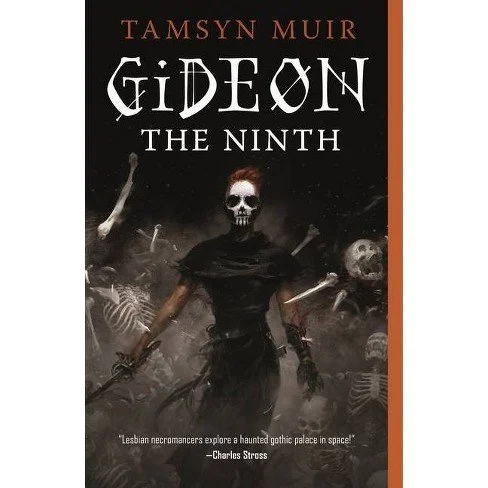
Cover of Gideon the Ninth by Tamsyn Muir, Art by Tommy Arnold

This was recommended to me by the author Karen Eisenbrey, and I’m so grateful. Tamsyn Muir’s novel is a challenge to describe. It’s a sci-fi fantasy in that it’s set in a distant future of what may be our universe, but there are supernatural elements. Specifically, some of the characters can perform necromancy, and the whole structure of their society is organized around that. The nature of that political organization becomes clear over the course of the novel, but it’s dribbled out slowly, so the reader only learns the way life works on the first planet where our characters live, then learns the way that planet fits in with the larger civilization over time. I appreciated the careful way Muir balanced the need to give the reader a lot if information about this universe without any boring data-dumps. 

There are a lot of other things I like more about the book. The choice to have necromancers accompanied by sword fighters makes for great action scenes. Even better, the book becomes a puzzle itself as the characters try to figure out how to achieve a goal without being killed by a mysterious monster who is picking them off. 

But these aren’t the best things in the book, either. The best thing about this book, hands down, is the protagonist, Gideon. Her voice is so funny that scenes which would have been dry become hilarious, and scenes that could have been saccharine become heart-wrenching. I want Gideon to sit with me at every staff meeting I have to attend for the rest of my life and make snide comments to me, shout insults when necessary, and occasionally threaten someone with her sword. Not the rapier. The two-hander.

I had a slight frustration with one of the elements of the ending that I think is sometimes done to death (hee-hee), but some friends assured me it would be complicated by events in the sequels, and I’ve already read far enough to know they’re right. So, you should expect to enjoy Gideon the Ninth, but be prepared to jump to the next novels in the trilogy right away.

Review of WE’LL FLY AWAY by Bryan Bliss

⭐⭐⭐⭐⭐

Hey, it’s February, and I’m still keeping my New Year’s resolution to review all the novels I read this year. I’m as surprised as you are!

Cover art by Matt Roeser


One of my most promising students, Shawn Stewart (keep an eye out for this talented aspiring writer!) recommended We’ll Fly Away by Bryan Bliss as a possible text for my creative writing classes. He correctly pointed to the use of a mixture of letters from one character and toggling back and forth between 3rd person limited points of view, something Bliss employs deftly, as a feature authors can learn from this book. But our larger conversation was about the quantity of hope we like in our books. We’ll Fly Away is a tragedy in the best way; it provides us with endearing but flawed characters who we know will not succeed, and it makes us desperately want them to succeed throughout. I felt too tense as I devoured this book in mere hours. I am very open with my students about the fact that I am not a fast reader, but this book made me one, not because it was written in that pulse-pounding, low-lexical-level prose appropriate for thrillers, but because, despite its rich, beautiful prose, I needed to know when and how the impending doom would befall the characters.  A bit of writing advice commonly misattributed to Vladimir Nabokov is, “The writer’s job is to get the main character up a tree, and then, once they are up there, to throw rocks at them.” (It seems the first framing of this advice came in a review of a play in the Bridgeport Herald of Bridgeport, Connecticut, in 1897, two years before Nabakov was born:  “The best advice ever given writers of farce is in these words: ‘In the first act get your principal character up a tree; in the second act, throw stones at him; in the third, get him down gracefully.’” Thanks, quoteinvestigator.com!) Bliss follows the most brutal version of this advice, giving us Luke and Toby as protagonists who are trapped in multiple ways: by poverty, by abusive or neglectful parents, by a system that has failed them over and over, and shares their dreams of escape as children who find a broken down airplane in the woods, teenagers looking for escape through sports, violence, romance, sex, alcohol, first loves, and often the pure and desperate desire to simply jump in a car and get as far away from their lives as possible. All the right things bring them back: love of family, girlfriends, responsibility, honor, and bravery, and we’re left screaming internally, “None of those things are worth your lives! Go! Go!”

Ultimately, I think I need a little more hope in my literature than We’ll Fly Away provides, but I’m very glad I read it to help me find that line previously held by Cormac McCarthy’s Blood Meridian. Not to spoil the ending, but I think We’ll Fly Away provides a quantity of hope just between McCarthy’s The Road and Blood Meridian (despite being unlike both those books in almost every way), and I’m not sure I have the constitution for anything more hopeless than The Road. But maybe I can find the same hope in We’ll Fly Away that I grasp for when reading Orwell’s 1984: This is a world we must not make! Unfortunately, We’ll Fly Away is a world that’s all too real for so many people, so many of the students I see come into my classroom each day, imprisoned in more ways than I can imagine. But I can hope for them, and We’ll Fly Away demands the reader close the back cover and get to work making a world that’s better than Luke and Toby’s.

Review of NEXT OF KIN by Melinda Mitchell

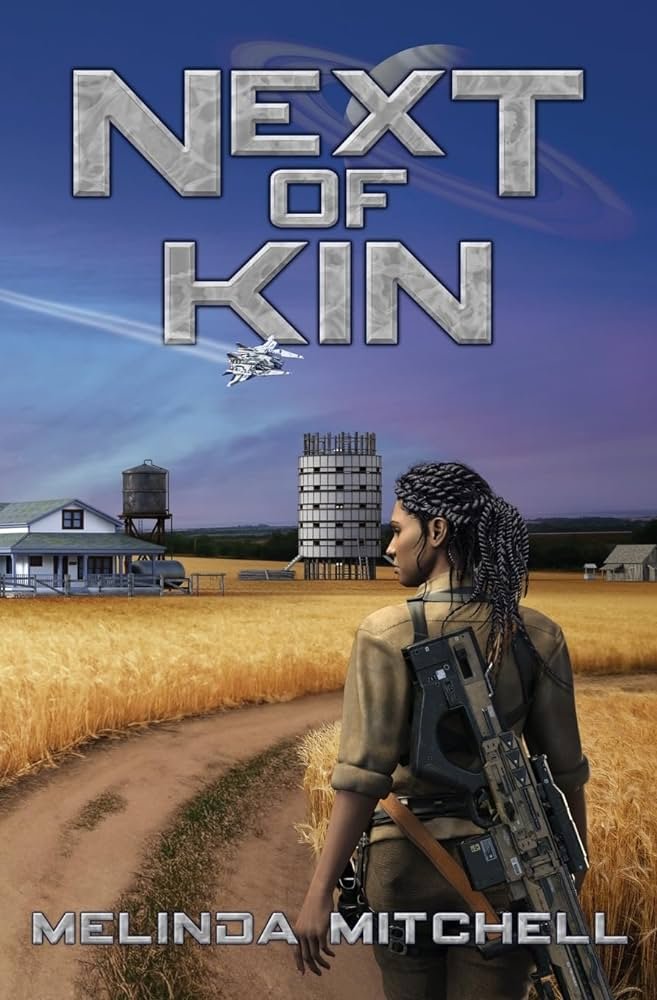
Cover art and design by Honor MacDonald

⭐⭐⭐⭐⭐

I’m keeping up with my New Year’s resolution to review all the novels I read this year, and I just finished Melinda Mitchell’s Next of Kin, the first in a planned series called Stardust and Ashes. I loved the premise for this book as soon as I heard about it: It’s the Book of Ruth as a space opera. In case you missed the Book of Ruth (it’s in the Bible, a pretty popular and easy-to-find anthology), it tells the story of a woman who comes to a foreign land after her husband has died. She returns to the land of her mother-in-law, finds a new husband, and becomes one of the great matriarchs of her new, adopted people. Mitchell resets the story amid conflicts between groups of humans fighting interstellar conflicts. There’s a lot to like here. It’s a sci-fi story. It’s an action/adventure story. It’s a military story. It’s a love story. It’s a story about a daughter and a mother. But I think the think I appreciated the most is that Mitchell turns it into a mystery. II was reminded of a creative writing master class of Eric Witchey’s. One of his lesson really stuck with me: Every story is a mystery. The question of whether or not the protagonist will succeed or fail (classical comedy/tragedy) should be a question of whether the protagonist will figure it out. “It” may be something about themselves or a solution to some external problem, but we are watching them attempt to reason their way out of some quandary. Mitchell’s story doesn’t seem like a mystery at first, but it resolves into a mystery, and the way it all comes together in the end shows elements from the beginning were essential clues the reader and protagonist needed all along. I also like the way Ami (Mitchell’s Ruth) has this varied but believable skill set, and her abilities all come into play in a believable way to allow her to succeed where no one else would have. 

Plus, it’s a really fun read!

(My other New Year’s resolution [or is it Not a Pipe Publishing’s resolution?] is to give out free ad space for authors on the Writers Not writing podcast/YouTube show, so if you have a book to advertise, send a 30-60 video to notapipepublishing@gmail.com. Be sure to include the title, your name, and where folx can find the book, and bear in mind that it’s also a podcast, so make sure all the important information is narrated. Just trying to help out my fellow authors!)


Review of Babel by R. F. Kuang

Artwork by Nico Delort

Continuing with my resolution to review all the novels I read this year (not counting manuscripts for Not a Pipe Publishing, so don’t worry, authors!), I find myself reviewing another novel that doesn’t need any of my support or praise to find readers. Too bad! I’m going to offer praise, anyway!

⭐⭐⭐⭐⭐ 

Rebecca Kuang’s Babel is a masterpiece, as you may have already heard. It tells the story of four students who are studying together at Oxford in the 1830’s. If that sounds a bit dry, I should add the students are there to study magic. Yeah, that should pull you back in, but what makes the book so brilliant is the magic system as metaphor. I don’t want to spoil anything, but this novel is not escapist fantasy nor some kind of nostalgic perversion of the past through rose tinted glasses. This is a book about the past and magic, but it’s a novel about the world we live in right now and the world we want to live in tomorrow. 

I know Babel been compared to Jonathan Strange & Mr. Norrell a lot, and there are certainly similarities in the scope of the story, the meticulous research required, the blending of history and magic, and the quality of the writing. I loved Jonathan Strange & Mr. Norrell, and I’m not disparaging it by saying Babel is alternate-history to illuminate our modern world, while Jonathan Strange & Mr. Norrell is alternate history as glorious escapist fun where the deeper meaning is in the characters and their humanity. Babel has those deeply human characters, but it is also commenting on our present political, economic, and social structures. It’s less like Jonathan Strange & Mr. Norrell and more like Gulliver’s Travels. Maybe it’s my writer bias, but I think I might compare Babel more to Cloud Cuckoo Land by Anthony Doerr, though Cloud Cuckoo Land is not set in one particular era of history and is less fantasy than sci-fi in that it abides by our univer’s laws of physics to highlight the …proverbial? …metaphorical? …literal-but-in-our-universe-and-therfore-not-fantastical? magic role of storytelling itself. Both Babel and Cloud Cuckoo Land are deeply researched, beautifully written, and will stick with you, but I’m struck by the way both are incredibly ambitious. Rebecca Kuang set out to tell a story of enormous scope and power, and whether she came up with the metaphor of her magic system first and endeavored to do it justice, or decided on the nuanced point she wanted to make and conceived of the magic system in order to do that, she has risen above the cleverness of the conceit of the novel to build something greater than the sum of any of its parts.

Be warned: Babel doesn’t let any of us off the hook about the harm we create in enabling and/or resisting colonialism, patriarchy, structural and cultural racism, and hyper-capitalism. To acquiesce is to cause suffering of the most vulnerable. To fight back is to cause suffering of the most vulnerable. None of us escape unscathed from Babel.

Review of Legends and Lattes by Travis Baldree

⭐⭐⭐⭐⭐

Cover art BY Carson Lowmiller

I didn’t understand the appeal of the cozy trend until I read Travis Baldtree’s Legends and Lattes. I was under the misapprehension that “cozy” meant “low stakes,” and “low stakes” mean boring, meandering, and possibly inconclusive. This was recommended by a handful of authors I admire, and they finally convinced me to check it out. And they are all correct; it’s a delight. “Cozy” might mean we don’t have great armies crashing into one another on battlefields, but nothing feels unimportant in this story of a retired sellsword and adventurer, Viv, trying to start the first coffeeshop in the town of Thune. I wanted her to succeed, I wanted her to make peace with her new life, and I wanted her to find love. This novel felt just as pulse-pounding as some murder mystery thriller, and a lot more exciting than some droning, plodding epic high fantasy because the characters were so well drawn and their concerns were relatable. Highly recommend.

Review: Martha Wells’ System Collapse

Cover art by Jaime Jones, cover design by Christine Foltzer.

This seventh entry in The Murderbot Diaries series doesn’t need my review, but I’m trying to be better about posting reviews of all the books I read and enjoy in order to support my fellow authors, even when, like Wells, they are getting the attention they deserve. System Collapse is a great addition to this series. SecUnit is going through some stuff, so while this book is as action-packed as the previous ones, there’s this added wrinkle which helps develop its character, a character I already loved. As a special bonus (and I don’t think this is too much of a spolier), Wells has this great scene where the creation of art and literature, complete with all the usual stresses an artist deals with when creating, is featured as the strategic move that saves the day in a very high stakes situation. Sure, that was preaching to the choir for me and the many authors and artists who love Wells’ work, but I appreciated it none-the-less.

⭐⭐⭐⭐⭐

Review of Wendy N Wagner’s An Oath of Dogs

I try to encourage my students to move beyond simple reviews of “good” and “bad,” and instead to consider who a work of art is made for. Are they the target audience? When it comes to Wendy N Wagner’s An Oath of Dogs, I suspect the target audience is: Me.

⭐⭐⭐⭐⭐

But maybe it’s for you, too. Are you skeptical of the power of rapacious corporations extracting profit at the expense of the environment and the working class who live in it? But do you also acknowledge the people involved are often conflicted or outright reluctant to participate yet cannot figure out a way to challenge the system? Do you like science fiction that explores highly relevant contemporary social issues while still being smart about technological and biological plausibility? Does the idea of colonizing space excite you while also worrying you because of our human history of colonialism? Do you have complicated feelings about religion, recognizing the dignity of religious people and the beauty of belief systems while also seeing the way religions can be systems of oppression people impose upon themselves and others? Do you like characters who are nuanced, flawed, and believable but ultimately likable and admirable? Do you like carefully constructed mysteries where the clues come together in a thoughtful, satisfying way? Oh, and do you like dogs? Then this book is for you, too!

One of the trickiest parts of writing a mystery on a colony world with a large cast of characters and is that Wagner has to manage an ending that resolves the mystery and lets us know where the characters end up without magically solving all the interplanetary environmental and socio-economic problems in the universe in a way that would feel inauthentic. I felt like all my questions about the characters were answered, but the larger issues still left me contemplating moral dilemmas in just the way Wagner intended. I do have one burning question remaining, though: Which Wendy N. Wagner book should I read next?

Ben Gorman immersed in writing as teacher, author and publisher

I made the paper! Here’s an article by David Hayes of the Itemizer Observer from November 1st, 2023, preserved in case it gets lost in their archives:

Ben Gorman immersed in writing as teacher, author and publisher

by David Hayes

November 1st, 2023

Ben Gorman, a creative writing teacher at Central High School, displays books printed by his company Not a Pipe Publishing Ink-Corporated, including his last novel “Don’t Read This Book,” and gives a sneak look at his latest novel, “You Were Warned."

Photo by David Hayes

Whenever Ben Gorman is at a public event, say Independence Days or Rose City Comic Con, inevitably someone will approach him and exclaim a non-sequitur that would leave onlookers not in on the reference scratching their head.

“Somebody will walk up and go, ‘The Magritte painting!’ and they’ll get the reference,” Gorman said, referring to Not a Pipe Publishing Ink-Corporated. “I’ll go, ‘I bet you were either a philosophy major or art history major.’ Almost without fail. Nice to have folks make that connection.”

The name of Gorman’s Independence-based publishing company refers to a work by French painter René Magritte, “this is not a pipe,” that represented a thing that is not a thing. An apt epithet, Gorman explained, for a company that features printed works that are all representation.

“It’s not the thing itself. It’s fiction representing our world in some way,” he said.

The first book Not a Pipe Publishing Ink-Corporated published in 2013 was one of Gorman’s works, figuring his tome would look more legitimate if it came from a local imprint, rather than going through the self-publishing route.

“I’d made so many mistakes in the publishing of this one book, I thought I can help a lot of other authors avoid those mistakes,” Gorman said.

Not a Pipe Publishing Ink-Corporated now has dozens of authors of both genre fiction and poetry, and Gorman’s latest novel has been added to the catalog -- “You Were Warned,” the sequel to his 2019 urban fantasy, “Don’t Read This Book.”

Now in his 19th year at Central High School, 23rd overall in education, Gorman teaches ninth grade English and creative writing for juniors and seniors. He couldn’t enjoy more being fully immersed in the writing industry and passing on his passion to the next generation.

“I get to teach creative writing, which is every writer’s dream. I get to talk about reading and writing all day,” Gorman said.

Tracing the evolution of the publishing industry, Gorman said there used to be very few big companies, and in order to break through, one had to pass through several levels of gate keeping. Gorman, in part, started Not a Pipe Publishing Ink-Corporated to circumvent the process, which was timed perfectly with a change in the industry.

“Technology changed, so you could now purchase a book and it could be printed after the fact. So you didn’t have to print a run of 10,000 books and keep these in the garage and hope for success,” Gorman said.

“It allowed for a company like ours to vet and decide who are these really talented authors whose books really deserved to be read then as people buy them they get printed,” he added.

The company has since grown significantly. Not a Pipe Publishing Ink-Corporated now features 43 titles in print and 80 authors under contract.

They started with genre fiction, especially by underrepresented authors, women, and people of color, which Gorman said has been important throughout.

Their biggest “get” came from participating in 2018’s Year of Publishing Women, which challenged publishers to commit to publishing only women for a year.

“That was huge for us, because it kind of put us on the map,” Gorman said. “We were one of two publishing companies in the world that participated. We took that challenge and made a big deal of it.

“Authors we signed that year have become our mainstays who keep coming back. That’s been really wonderful for the company, to be an outlet to help folks who otherwise get mistreated by this industry.”

They have published more authors from the Pacific Northwest than anywhere else, including Portland, Seattle and Grants Pass. But they’ve also accepted submissions from authors in England, Norway and Pakistan. Not a Pipe Publishing Ink-Corporated has an open submission period every August, when they receive hundreds of books that they winnow down to asking for full transcripts from about 10.

“But we can’t publish 10 a year. It’s a really tough challenge to do three or four in addition to sequels to previous authors,” Gorman explained. “It looks like next year we may publish eight or nine, which is a lot for us, but they’re so good really have a hard time turning these away.”

The small company consists of Gorman, co-owner and fiancé Chrystal Law, who also owns Bricks & Minifigs in Salem, who handles the marketing side. They have a team of freelance folks, editors who evaluate submissions. But the entire paid staff is just Gorman.

“We’re ready to grow. We need to grow. We need more people if we’re going to do more, otherwise we need to stay same size,” he said.

The irony to Gorman’s first novel is he most definitely wants you to read, “Don’t Read This Book.” He calls it the first in a trilogy with a “what if” premise.

“What if all the monsters in mythology actually existed in our world and got together once a year at a convention in Las Vegas to talk about how to keep themselves secret,” Gorman said. “Things go awry when one of them tricks the rest into abducting and forcing this human author to write a book that is so scary, it will kill anyone who reads it. The other monsters think this might be a great idea, not realizing if all the humans are killed, they lose their food supply.”

The sequel, “You Were Warned,” continues the saga of killer monsters.

“It’s a fun kind of adventure, with underneath, I hope, a much deeper book questioning our own mortality and how our identities play into our ability to acknowledge that we are human,” Gorman said. “And this one has baby werewolves. Who doesn’t like baby werewolves?”

He hosted a launch party for “You Were Warned” Oct. 28 at Rose City Book Club, along with fellow Not a Pipe Publishing Ink-Corporated author Kate Ristau promoting the third in her trilogy. Gorman said no local events promoting his book have been scheduled yet.

He added the U.S. culture has entered a time where books and authors are under attack and now is perfect to support those who deserve the public’s thanks.

“Kate Ristau has a wonderful afterword in her latest release thanking librarians. I just encourage everyone, please, support librarians. Support local bookstore owners. Support authors, support people fighting for books and freedom of books,” Gorman said. “There are a lot of forces out there that are trying to stifle what is getting into people’s hands.”